
Menu
Minute for Mission
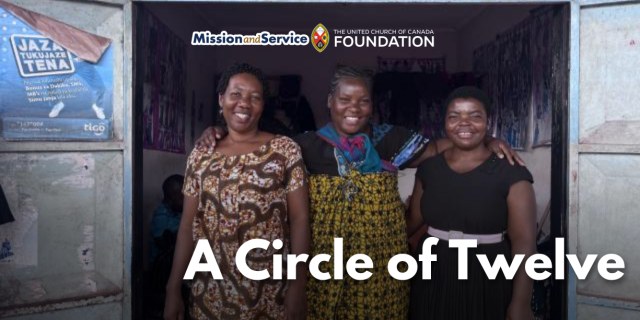
A Circle of Twelve
There’s a particular feeling that comes with visiting longtime companions in ministry, a sense of stepping into a story that began long before you arrived and will continue long after you leave. I felt it immediately on my first trip to Tanzania. Since 1979, The United Church of Canada has been accompanying the work of the Morogoro Women’s Training Centre (MWTC), a unit of the Christian Council of Tanzania, in Tanzania, supporting their locally-led efforts that empower women. One of those efforts, run in 2023 with the support of Mission and Service, included a holistic training for mothers of children with disabilities. The program wove together self‑esteem and confidence building, small business and entrepreneurship skills, financial literacy, emotional support, and practical knowledge about caring for children.
It was a space where women learned, but also where they were seen, heard, and held by one another. Many of the women spoke of the “before.” Of years marked by isolation, stigma, and the heaviness of carrying their child’s needs alone. Some described shame that kept them hidden, or fear of being misunderstood by neighbors, their church community, and even family. Their love for their children was unwavering, but the loneliness was real. What’s grown after their time at MWTC is something far more powerful than what any single training session could offer: they found one another. They found language for their experiences. They found community where shame once lived, and possibility where isolation once closed in. The relationships they built became an ongoing source of strength.
There were twelve women in the training that week—twelve stories and twelve journeys being strengthened in community. I couldn’t help but notice the echo of another circle of twelve. God has always used small groups of ordinary people to carry hope into the world. These women, too, are bearers of that hope. Among the twelve, three shared that their husbands had left after their child was born with a disability. It was a quiet grief woven into their stories, shaped by the stigma that still surrounds disability in many communities. In the absence of that support, the women leaned even more on one another, finding in community what had been withdrawn at home.
Agness Mduma carries a vibrant, steady strength. She is a widowed mother of four, and for sixteen years she has been raising her youngest child, who lives with a disability, largely on her own. When her husband died, that baby was just over a month old. The grief, the responsibility, the uncertainty of how she would provide for her family all arrived at once. Before she connected with MWTC, life pressed in from every direction. Her income‑generating activities brought in very little. Markets were limited. Opportunities were scarce. And like so many mothers of children with disabilities in Tanzania, she carried the weight of it alone.
The training she received didn’t erase the hardship, but it opened a door. With startup capital and new skills, Agness began selling charcoal, at first in small amounts. She added local chickens and started selling eggs. Then she opened a small grocery shop and started baking cakes. Each step was modest, but each one widened the circle of possibility. What struck me most was not the list of businesses she now runs, but the way she spoke about herself. The training gave her tools, but it also strengthened her confidence. She talked about learning to save, to plan, to trust her own decisions. She talked about raising her child with renewed courage. Her efforts have allowed her to support her children’s education, meet daily needs, and even renovate her home. She is still navigating challenges. Her child’s medical needs are high, and health insurance remains out of reach, but she is no longer standing on unstable ground. Her story is one of resilience unfolding in real time.
These stories are reminders of what accompaniment makes possible. Not quick fixes. Not tidy narratives. But the slow, steady work of walking together. The kind of work that honors dignity, nurtures resilience, and allows women to discover strength in one another. (Amy Zavitz is Global Partnership Program Coordinator, Africa Partnerships, with The United Church of Canada General Council Office)
– Thank you –
Refugee Project
Nov 17, 2022
As we watch with disbelief a war waging in the Ukraine and over 600,000 being displaced in under one week fleeing the bombs, we appreciate the greater need that exists to welcome refugees. Our faith calls us to respond and through this ministry, we try to answer this call. Our Lenten Project for this year was our St. Paul’s Refugee Campaign, to raise funds for our work with refugees. As you know, we are working with St. Mark’s Anglican/Lutheran Church to sponsor a family from Syria who just last week arrived here in Canada. We are also working with a local Afghani family in co–sponsoring six members of their family who have fled Afghanistan and the have now arrived. With the invasion of Ukraine, we know that there are now many more refugees who have fled their homes and we have no idea if they will be able to safely return to their own country or not.
To donate to our Refugee fund, please make your cheque payable to St. Paul’s United Church and clearly mark on the memo line of the cheque that is for the Refugee Fund. If you are making an e–transfer or donation online through our website, then please indicate that it is for this fund. Thank you

Scott Warnock, Executive Director of the Huronia Community Foundation, presents a cheque for $2,000 to Ken Woods, of St. Paul’s Refugee Committee.
_______________________
St. Paul’s United Church in Midland is in the process of sponsoring a family from Afganistan, and is also assisting St. Mark’s Anglican – Lutheran church as they are sponsoring a family from Syria.
St. Paul’s has a long history of sponsoring refugees going back to the 70s with the sponsorship of a family fleeing Vietnam after the war.
All funds raised will be used to cover the costs of supporting the refugee families once they arrive in Canada, for the sponsorship period of 12 months.
Refugee Programs
We asked Rev Martin Giebel, from St. Mark’s, for an update on the Ismail and Maghrebi families which is included here.
The Ismail family (from Syria): all the children are in school, enjoying it and making progress both in English and academically. The father is employed. Regarding the son who is still in Germany, his application is now at the Vienna visa office – it’s progressing.
The Maghrebi family (from the Ukraine): everyone doing well. They are now in their own apartment.
The Maghrebi family are in touch with the Ismail family and Rev. Martin visits both regularly. The two mothers, Jihan and Svitlana, are forming a friendship even though both hardly speak any English – they ‘understand’ each other.
Everyone takes ESL lessons. Rev Martin is trying to establish in-person ESL in Midland.
We have a Travel Date for the family from Afghanistan; for now, it is for late October (no names and dates are included for their safety). We are making efforts to bring them to Canada as soon as possible as the situation where they are is very dangerous; we are very concerned.
We are all grateful for the safe arrival of all refugees; please pray for those who are still waiting to travel to Canada, and safety.
This family has arrived and more information will be forth coming.